


Important: Neither Sunsafe Rx nor Heliocare nor any other supplement are classified as sunscreens under FDA regulations, which define sunscreens as OTC drug products containing specific topical chemicals. Oral supplements for skin protection should always be used in combination with a topical sunscreen lotion during direct sun exposure. The research cited in this article refers to the individual ingredients in these products, not the products themselves.
Introduction
Sun protection has long meant slathering lotion on your skin before heading outside. But a growing body of published clinical research points to a second, equally important layer of protection — one that works from the inside out.
It’s called oral sunscreen. And despite what the name might suggest, it is not a pill that replaces your SPF. It is a daily antioxidant supplement that works systemically — helping your skin defend itself against UV-induced free radical damage, inflammation, and premature aging at the cellular level.
Products like Sunsafe Rx and Heliocare are the most well-known examples. Dermatologists have been recommending them for decades. The science behind them is real, it is published, and it is compelling.
This guide covers everything you need to know: what oral sunscreen is, how it works, what the research actually shows, what ingredients matter, how to choose a quality formula, and how to use it as part of a complete skin protection strategy.
What Is Oral Sunscreen?
Oral sunscreen refers to dietary supplements — typically capsules or tablets — containing antioxidant ingredients that have been clinically shown to help protect the skin and eyes from UV-induced damage when taken daily.
Unlike topical sunscreens that sit on the skin surface and reflect or absorb UV rays, oral sunscreen works systemically. After ingestion, the antioxidant ingredients are absorbed into the bloodstream and distributed throughout the body — including to skin cells and eye tissue — where they help neutralize free radicals generated by UV radiation.
The most researched ingredients include Polypodium leucotomos extract (the key ingredient in both Sunsafe Rx and Heliocare), astaxanthin, lycopene, green tea extract (EGCG), grape seed extract, lutein, zeaxanthin, and omega-3 fatty acids (DHA and EPA). Additionally, certain specific vitamins and minerals have also shown photoprotective properties.
How Does Oral Sunscreen Work?
To understand why oral sunscreen works, you need to understand what UV radiation actually does to your skin.
What UV Radiation Does
When UV rays hit your skin, they trigger a cascade of cellular damage:
-
Free radical generation — UV radiation creates unstable molecules that attack skin cells, collagen, and DNA
-
DNA strand breaks — direct damage to skin cell DNA that drives mutations and aging
-
Inflammation — the skin’s immune response causes redness, swelling, and longer-term damage associated with inflammatory skin conditions such as eczema
-
Collagen degradation — UV accelerates the breakdown of collagen, driving wrinkles and sagging
-
Hyperpigmentation — UV triggers excess melanin production, causing dark spots and uneven skin tone associated with conditions such as melasma
Every second of every day — not just at the beach — your skin is exposed to environmental stressors that generate this kind of damage. Sunscreen lotion helps at the surface. But the UV rays that get through cause damage — and the cumulative damage from years of daily exposure is where oral antioxidants make a critical difference.
How Internal Antioxidants Help
The ingredients in oral sunscreen supplements work through several complementary pathways:
1. Free Radical Neutralization
Antioxidants like astaxanthin, lycopene, grape seed extract, and vitamin C directly neutralize UV-generated free radicals before they can damage skin cell structures. These antioxidants come from natural sources — foods and plants — which is exactly why they are not only effective but also safe and beneficial for your entire body, not just your skin.
2. Anti-Inflammatory Defense
Polypodium leucotomos extract, the EGCG in green tea, and astaxanthin have well-documented anti-inflammatory activity. Multiple clinical trials show they reduce UV-induced erythema (skin redness from exposure to UV rays) — measurably lowering the inflammatory response and damage caused by sun exposure.
3. DNA Damage Protection
Studies on Polypodium leucotomos extract show the ingredients help protect skin cell DNA from UV-induced strand breaks and oxidative damage. This is the mechanism by which the ingredients help prevent photoaging and support photosensitive skin conditions.
4. Continuous, Whole-Body Coverage
Because it works systemically, oral sun protection supplements provide something topical sunscreen cannot: continuous protection across the entire body — including hard to reach areas that make it difficult to apply lotion — without being washed off by sweat or water. These antioxidants work internally 24 hours a day, not externally solely when you remember to reapply lotion.
Does Oral Sunscreen Work? What the Research Says
This is the question most people ask — and the answer, based on published clinical evidence, is a clear yes.
There is extensive research to show that the ingredients in oral sunscreen supplements protect skin and eyes from UV-induced damage. This is not emerging, preliminary science. These ingredients — particularly Polypodium leucotomos and some specific carotenes and polyphenols — have been studied in clinical trials for many decades.
Published Research Highlights
-
Polypodium leucotomos (In Formulations Including Antioxidine® & Fernblock): Multiple placebo-controlled clinical trials show PL extract significantly reduces UV-induced erythema, decreases oxidative DNA damage in skin cells, and supports management of photosensitive conditions including polymorphous light eruption (PMLE) and solar urticaria.Studies published in the Journal of the American Academy of Dermatology and Photodermatology,Photoimmunology & Photomedicine.
-
Astaxanthin: Human clinical trials show astaxanthin supplementation reduces UV-induced skin deterioration, improves skin moisture and elasticity, and decreases reactive oxygen species in UV-exposed skin. A 2017 study published in Nutrients demonstrated significant improvements in multiple skin parameters.
-
Lycopene: Research published in the British Journal of Dermatology demonstrated that dietary lycopene reduced UV-induced erythema by up to 40% in human subjects. Lycopene concentrates in skin tissue and acts as a potent free-radical scavenger.
-
Green Tea Extract (EGCG): Multiple studies show EGCG and other green tea polyphenols reduce UV-induced DNA damage, lower inflammatory cytokines, and support skin cell recovery after UV exposure. Published in the Journal of Nutrition and Cancer Prevention Research.
-
Grape Seed Extract (Oligomeric Proanthocyanidins (OPC)): Rich in oligomeric proanthocyanidins — among the most potent known antioxidants. Research supports their role in UV photoprotection, collagen protection, and anti-inflammatory activity in skin tissue.
-
Lutein & Zeaxanthin: Accumulate in both skin and eye tissue. AJCN study shows increased skin carotenoid levels and reduced UV reddening. Unique in providing both skin and eye protection.
-
Omega-3 (DHA and EPA): Well-documented anti-inflammatory and skin barrier support in clinical literature.
Products like Sunsafe Rx — which combine all of these ingredients plus supportive vitamins and minerals (Vitamin C, Vitamin E, Mixed Carotenes, Zinc, Selenium) at clinically relevant doses — have a substantial body of ingredient-level evidence behind them. Heliocare, which relies primarily on Polypodium leucotomos alone, has strong evidence for use as an individual ingredient but lacks the breadth of Sunsafe Rx’s multi-antioxidant formula with 13+ clinically researched ingredients.
Key Ingredients to Look For
Not all oral sunscreen supplements are equal. The effectiveness of a sunscreen pill depends entirely on which ingredients it contains and at what doses. The best ingredients come from natural sources — foods and plants — and have published clinical research supporting their photoprotective effects. The best products also contain the relevant ingredients at efficacious doses.
Polypodium Leucotomos Extract
The gold standard ingredient in oral photoprotection. This extract comes from a tropical fern and has been studied for decades. Found in both Sunsafe Rx (as part of Antioxidine®) and Heliocare (as Fernblock). Multiple JAAD trials show it reduces UV-induced erythema, DNA strand breaks, and PMLE severity.
Astaxanthin
One of the most powerful antioxidants known to science. Found naturally in marine microalgae — it’s the natural pink/red pigment in salmon. Found in Sunsafe Rx but not in Heliocare. Studies in Nutrients 2017 and Acta Biochimica Polonica 2012 show improved skin moisture, elasticity, and reduced UV damage markers.
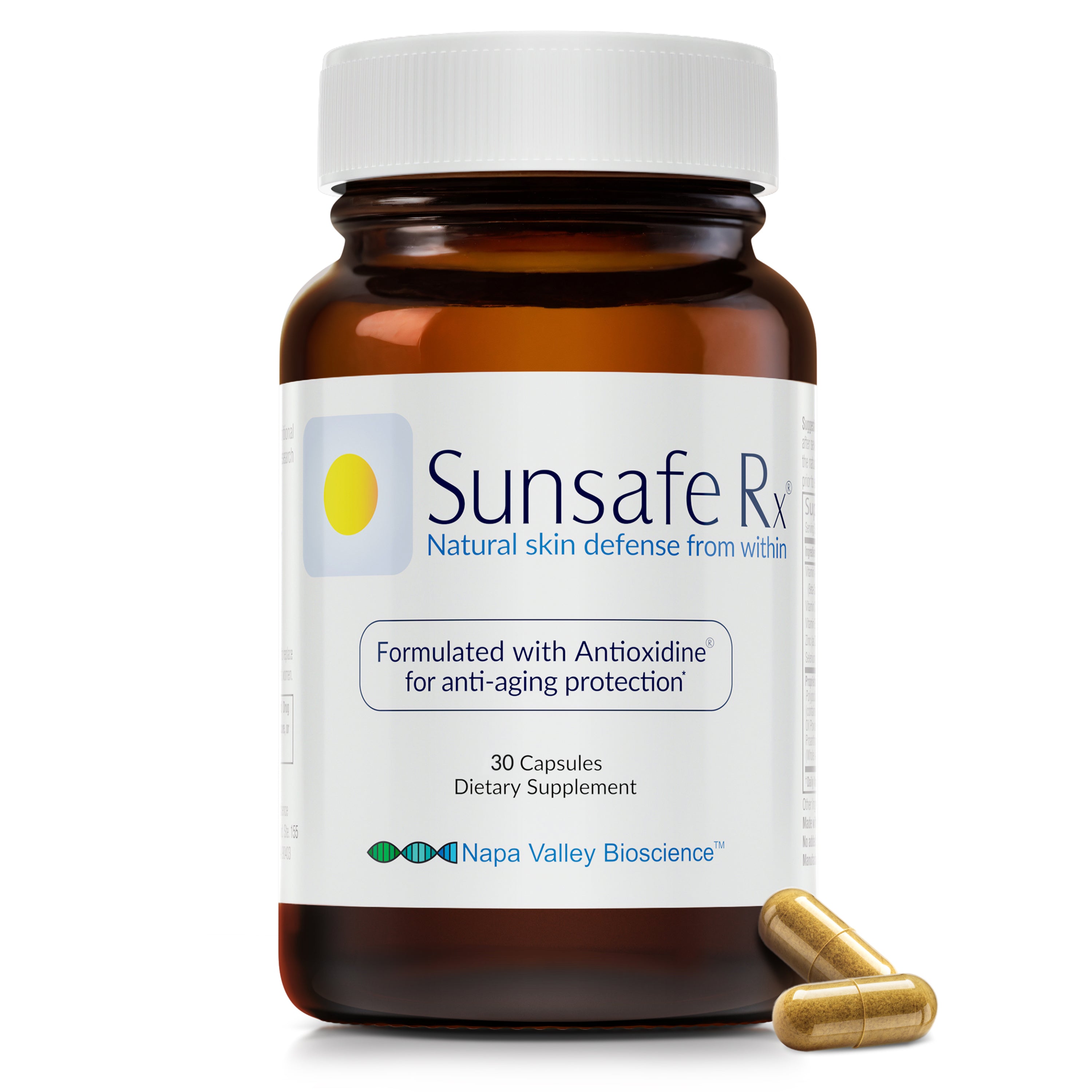
Featured Product
Sunsafe Rx: Natural Anti-Aging Protection
Sunsafe Rx is made with ingredients clinically proven to protect your skin and eyes. One capsule per day provides natural, anti-aging protection and improves the appearance of your skin. Empower your skin from within—while supporting the health of your whole body. This is next-generation skincare. This is Sunsafe Rx.
Lycopene
A carotenoid found naturally in tomatoes and other red fruits. It accumulates in skin tissue and provides measurable UV protection. Found in Sunsafe Rx but not in Heliocare. British Journal of Dermatology research shows up to 40% reduction in UV-induced erythema.
Green Tea Extract (EGCG)
Widely studied for both photoprotection and anti-aging activity. The key active compound, EGCG (epigallocatechin-3-gallate), is found in green tea leaves. EGCG helps protect collagen, reduce DNA damage from UV exposure, and lower inflammatory responses. Found in Sunsafe Rx but not in standard Heliocare formulas.
Grape Seed Extract (OPC)
Derived from grape seeds (Vitis vinifera). Rich in oligomeric proanthocyanidins — one of the most potent known free-radical scavengers. Supports skin resilience, collagen protection, and environmental stress response. Found in Sunsafe Rx. Not in Heliocare.
Lutein & Zeaxanthin
Found in marigold flowers and leafy green vegetables. Unique among oral sun protection ingredients in that they protect both skin AND eyes. They accumulate in the macula and skin tissue, filtering harmful wavelengths and reducing photodamage. Found in Sunsafe Rx. Heliocare does not provide meaningful eye protection.
Omega-3 (DHA and EPA)
Essential fatty acids with well-documented anti-inflammatory and skin health benefits. Also aid the absorption of other active ingredients. Found in Sunsafe Rx. Not in Heliocare.
Also Included in the Sunsafe Rx Formula
Vitamin C, Vitamin E, Mixed Carotenes (Beta-Carotene, Alpha-Carotene), Zinc, and Selenium provide additional antioxidant and supportive benefits — free-radical defense, collagen support, immune function, and antioxidant enzyme activity.
What This Means for Choosing a Product
Sunsafe Rx’s Antioxidine® complex contains all of the above — a full spectrum of 13+ clinically researched, plant-derived antioxidants. Heliocare relies almost entirely on Polypodium leucotomos alone and also contains hydroxypropyl methylcellulose (HPMC), a semisynthetic polymer, whereas Sunsafe Rx is made from natural foods and plants. An objective comparison — based solely on ingredient breadth, published research, and number of health benefits — points clearly to Sunsafe Rx as the more complete internal skin defense solution.
And here’s something worth emphasizing: these antioxidants from nature are not only effective for your skin — they are healthy for your whole body. Antioxidants from foods and plants support immune function, cardiovascular health, eye health, anti-inflammatory activity, and cellular longevity. They can even decrease the formation of wrinkles and age spots and improve the appearance of your skin.
Not All Oral Sunscreens Are Equal: Why Results Vary by Formula
The Ingredient Source Matters
Look for natural ingredients from foods and plants. The most effective and safest oral sunscreen ingredients are those derived from natural botanical sources — ferns, marine algae, tomatoes, grapes, green tea, and leafy greens. Sunsafe Rx is made from natural foods and plants. In contrast, some competitors like Heliocare contain semisynthetic ingredients such as HPMC.
The Formula Breadth Matters
UV damage is not caused by a single mechanism — it involves free radicals, inflammation, DNA damage, and collagen degradation happening simultaneously. A single-ingredient product can only address one or two of these pathways. A multi-ingredient formula addresses all of them at once. This is why Sunsafe Rx’s Antioxidine® complex — with 13+ clinically researched antioxidants — delivers more comprehensive protection than single-ingredient products like Heliocare.
Dose and Bioavailability Matter
An ingredient present at a sub-clinical dose will not deliver the effects shown in clinical research. Look for products that use standardized extracts at doses consistent with published human trials.
How to Evaluate an Oral Sunscreen Brand: What to Look For
1. Look for Natural Ingredients from Foods and Plants
The most credible oral sunscreen formulas use ingredients that come from nature — ferns, marine algae, fruits, vegetables, and plant extracts. Ingredients from natural food sources are not only effective — they are good for your whole body, supporting health beyond just your skin.
2. Manufacturing Quality: Made in the USA, FDA-Registered, NSF Certified, Product Testing
This is one of the most important quality signals you can look for.
-
Made in the USA: GMP manufacturing standards in the United States are among the most stringent in the world. Products made in the USA in FDA-registered facilities are held to a higher standard of quality, purity, and consistency than products manufactured overseas.
-
FDA-Registered Facility: Manufacturing in an FDA-registered facility means the facility meets federal standards and is subject to FDA inspections.
-
NSF Certified: NSF certification involves independent third-party testing and verification of manufacturing practices, ingredient quality, and product claims. This is the gold standard in objective, independent, 3rd party certification.
-
Product Testing: Quality control testing of all raw materials prior to use, and finished batches prior to release, is crucial to consistently producing a high-quality product.
Sunsafe Rx is manufactured in the USA in an FDA-registered, NSF-certified facility — and has been since 2010. Every Sunsafe Rx ingredient and batch is also stringently tested and must pass exacting standards for quality, potency, and purity, and screened for heavy metals, contaminants, and other toxins. This reflects the company’s commitment to a premium product with verifiable quality standards.
3. Clinical Research Behind the Ingredients
Does each ingredient in the formula have published clinical research supporting its photoprotective effects? Look for peer-reviewed studies in dermatology journals, not just marketing claims. Sunsafe Rx can show independent clinical research for every ingredient in its proprietary Antioxidine® formula.
4. Avoid Cheap Brands and Unverified Formulas
Be cautious of cheap brands that use minimal doses of key ingredients, products that lack transparency about ingredient sources or doses, formulas with one or two trendy ingredients but no published research supporting their use, and products making extreme claims about sun protection, SPF equivalence, or disease treatment. In the oral sunscreen category, as with most premium nutritional supplements, you get what you pay for.
Oral Sunscreen vs Topical Sunscreen: How They Compare
|
Feature |
Oral Sunscreen (e.g. Sunsafe Rx) |
Topical Sunscreen |
|
How it works |
Systemically — absorbed into bloodstream, distributed throughout the body, and accumulated in the skin |
Topically — sits on skin surface, absorbs/reflects UV rays |
|
Coverage area |
Whole body, including hard-to-reach areas, lips, eyes |
Only where applied |
|
Duration |
All day — not affected by sweat or water |
Must reapply every 2 hours; washed off by sweat/water |
|
Protection type |
Free radical neutralization, anti-inflammatory, DNA protection, anti-aging |
UV ray filtration at the skin surface |
|
Eye protection |
Yes (lutein/zeaxanthin) |
No |
|
Anti-aging benefits |
Extensive — collagen support, antioxidant defense, DNA protection, wrinkle and sun spot prevention |
Limited to UV blocking at surface |
|
Easy of use |
Simple. Just take one capsule per day. Take one additional capsule prior to exposure if needed. |
Application can be messy, time-consuming, and inconvenient. Doesn’t work if not timely applied. Re-application might be necessary. |
|
Replaces the other? |
No — complements topical SPF |
No — complements oral antioxidants |
The best strategy is both. Topical sunscreen blocks UV at the surface. Oral antioxidants protect everything else — the damage that gets through, the cumulative daily exposure, the areas you missed, and the systemic free-radical damage that no lotion can stop.
Who Benefits From Oral Sunscreen?
-
People with high daily sun exposure: Outdoor workers, athletes, gardeners, drivers — anyone who accumulates significant UV exposure as part of daily life.
-
Those managing photosensitive conditions: Multiple clinical studies show the ingredients in these supplements, particularly Polypodium leucotomos, help manage polymorphous light eruption (PMLE), solar urticaria, and photosensitive skin. Dermatologists have been recommending these ingredients for photosensitivity patients for decades.
-
Anti-aging focused individuals: UV is the #1 driver of skin aging. Daily oral antioxidants provide the most consistent, continuous defense against photoaging available.
-
People who don’t get enough antioxidants from plants: Many people do not consume enough plant-derived antioxidants through food alone. An oral sun protection supplement delivers the same plant-based antioxidants in concentrated, standardized doses.
-
People who struggle with topical sunscreen: Oral supplementation adds meaningful protection for those with chemical sunscreen allergies or sensitivities, and anyone who consistently forgets to reapply.
-
Anyone who wants more comprehensive coverage: Even diligent sunscreen users leave gaps.Internal antioxidants protect every cell in your body, not just the areas you can reach with a bottle.
How to Use Oral Sunscreen for Best Results
-
Take it daily: Consistency is key. The antioxidant ingredients accumulate in skin and eye tissue over time. Daily use — especially year-round, not just in summer — yields the best results.
-
Take it before sun exposure: Most recommendations suggest taking your supplement 30–60 minutes before expected sun exposure. But because the protection is systemic and builds over time, daily dosing provides continuous support regardless of timing.
-
Keep using topical SPF and other sun protection methods: Oral antioxidants supplement your sunscreen routine — they do not replace it. Continue wearing broad-spectrum SPF 30+ and reapplying every 2 hours during prolonged sun exposure, along with staying out of the sun when possible, and covering exposed skin while in the sun.
- Give it time: Internal photoprotection builds gradually. Most users notice the most significant effects after several weeks and even months of consistent daily use.
Frequently Asked Questions About Oral Sunscreen
Q1: What is oral sunscreen?
Oral sunscreen is a dietary supplement containing antioxidant ingredients — typically derived from plants and foods — that have been clinically shown to help protect skin and eyes from UV-induced damage. It works systemically, distributing protective antioxidants throughout the body.
Q2: Does oral sunscreen really work?
Yes. The ingredients in quality oral sunscreen supplements — particularly Polypodium leucotomos extract, astaxanthin, lycopene, green tea EGCG, grape seed extract, lutein/zeaxanthin, and omega-3 — have been studied in multiple published clinical trials and shown to measurably reduce UV-induced skin damage. This is a substantial, peer-reviewed body of evidence.
Q3: Can oral sunscreen replace topical sunscreen?
No. Oral sunscreen supplements are not classified as sunscreens by the FDA, which defines sunscreens as topical OTC drug products. They should always be used in combination with topical broad-spectrum SPF during sun exposure — as a complement, not a replacement.
Q4: How long does it take to see results?
Protection builds gradually as antioxidant levels accumulate in skin and eye tissue. Most users report the most noticeable benefits after 2–4 weeks of consistent daily use, though systemic antioxidant activity begins immediately. For best results, use year-round.
Q5: Who should take oral sunscreen?
Anyone who wants to add an inside layer to their skin protection strategy. Particularly beneficial for people with high daily UV exposure, photosensitive skin conditions, anti-aging goals, or those who don’t consistently apply topical SPF. Also beneficial for people who don’t get enough antioxidants from vegetables, fruits, and other plant foods.
Q6: What is Polypodium leucotomos?
Polypodium leucotomos is a tropical fern extract — the most extensively studied ingredient in the oral photoprotection category. It is found in both Sunsafe Rx (as part of the Antioxidine® complex) and in Heliocare (as Fernblock). Multiple placebo-controlled clinical trials show the ingredient reduces UV-induced erythema, protects skin cell DNA, and supports management of photosensitive skin conditions.
Q7: Is oral sunscreen safe?
Yes. The ingredients in quality oral sunscreen supplements — all derived from natural food and plant sources — have strong safety profiles and have been used for decades without significant adverse effects. Consult a healthcare professional if you are pregnant, breastfeeding, or taking prescription medications.
Q8: What is the best oral sunscreen ingredient?
The most studied single ingredient is Polypodium leucotomos extract. For comprehensive protection, the best formulas combine multiple clinically researched ingredients. Sunsafe Rx’s Antioxidine® complex includes 13+ clinically researched ingredients from natural food and plant sources. Heliocare contains primarily PL extract alone.
Q9: Can oral sunscreen prevent sunburn?
The ingredients in oral sunscreen supplements should not be relied on to fully prevent sunburn on their own. Oral antioxidants are best used as part of a comprehensive sun protection strategy that also includes topical broad-spectrum SPF 30+, protective clothing, hats, and shade when possible. The ingredients work at the cellular level to reduce UV-induced oxidative damage, inflammation, and DNA damage — but they are not a substitute for blocking UV rays at the surface.
The Bottom Line
Oral sunscreen is not a gimmick or a new trend. It is a clinically validated category of supplementation backed by decades of published research. The ingredients — particularly when combined in a comprehensive formula like Sunsafe Rx’s Antioxidine® with 13+ clinically researched ingredients — provide measurable, meaningful protection against UV-induced skin damage, photoaging, and inflammation.
Does oral sunscreen work? Yes. Extensively. Unambiguously. The research is clear.
Is it a replacement for topical SPF? No — and it was never meant to be. It is the inside layer of a complete skin protection strategy. Topical sunscreen handles the surface. Oral antioxidants handle everything else.
The best formulas use natural ingredients from foods and plants — the same antioxidants found in a healthy diet, delivered in standardized, clinically researched doses. They are manufactured in FDA-registered, NSF-certified facilities with the highest quality standards. And they are good not just for your skin, but for your whole body.
For anyone serious about long-term skin health and anti-aging, adding a high-quality oral sun protection supplement to your daily routine — alongside topical SPF, protective clothing, hats, and shade when possible — is one of the most impactful decisions you can make for your skin.
Ready to try the most comprehensive oral sun protection supplement available?
Sunsafe Rx combines Polypodium leucotomos, astaxanthin, lycopene, green tea extract (EGCG), grape seed extract, lutein, zeaxanthin, omega-3 (DHA and EPA), vitamin C, vitamin E, mixed carotenes, zinc, selenium, and more into one daily capsule — 13+ clinically researched ingredients making it the most complete internal skin defense supplement on the market. Made from natural plant and food sources. Manufactured in the USA in an FDA-registered, NSF-certified facility. Recommended by dermatologists since 2010.
Disclaimer
Published clinical data does support the use of these ingredients for a wide range of skin conditions, including photosensitivities, pigment-related conditions such as vitiligo, and photodermatoses, and the prevention of photoaging and free-radical damage in skin and eyes.
However, the FDA defines sunscreens as over-the-counter drugs with specific chemicals that either reflect or absorb UV rays. As such, oral photoprotective products should not be considered sunscreen or SPF, and are not allowed to make disease claims.
Sunsafe Rx is classified as a dietary supplement with ingredients that published clinical research shows support skin health, promote the skin’s natural defenses against environmental damage, and reduce the appearance of skin aging. It should be used as part of an internal skincare solution and always used in combination with topical sunscreen lotions for external protection during sun exposure. Consult a healthcare professional before starting any new supplement if you are pregnant, breastfeeding, or taking prescription medications.
Written by Sunsafe Rx Team |
