

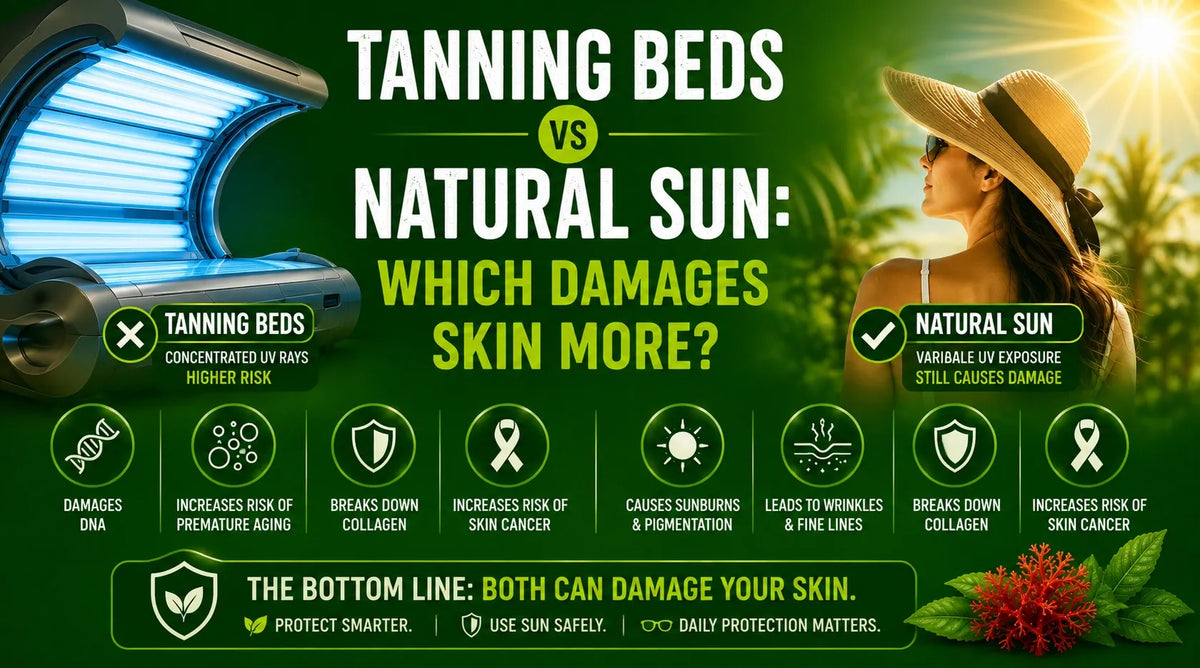
Tanning Beds vs Natural Sun: Which Damages Skin More?
Introduction
"At least it's not as bad as a tanning bed" is something people sometimes tell themselves while lying out in natural sunlight. It's a comforting idea — but is it actually true? Both natural sunlight and indoor tanning beds expose skin to ultraviolet (UV) radiation, and both carry real, well-documented risks. This guide breaks down what the research actually shows about tanning beds vs. natural sun, so you can understand the real risk, not just the common assumptions.
What Actually Happens in a Tanning Bed vs. Natural Sunlight
Natural sunlight contains a mix of UVA and UVB radiation, with the ratio varying by time of day, season, and location. Indoor tanning beds are designed specifically to produce a tan quickly, which typically means concentrated UVA exposure (often emitting UVA at levels far more intense than midday sun), sometimes combined with UVB.
Both UVA and UVB penetrate skin and contribute to DNA damage, but they act somewhat differently: UVB is the primary driver of sunburn and is strongly linked to skin cancer, while UVA penetrates more deeply into the skin and is a major contributor to premature aging (photoaging) and also plays a role in skin cancer development. Both come down to the same underlying process — how UV rays affect your skin.
The Research: Which Is More Dangerous?
The short answer, according to major health authorities: both are dangerous, and tanning beds carry a distinctly avoidable, concentrated risk that natural sun exposure (which at least can offer some benefits, like vitamin D synthesis) does not offset.
The World Health Organization's International Agency for Research on Cancer (IARC) classifies UV-emitting tanning devices as Group 1 carcinogens — its highest risk category, the same classification given to natural UV radiation, asbestos, and tobacco smoke. Being in the same classification tier doesn't mean tanning beds and natural sun are equally risky in absolute terms, but it confirms that indoor tanning is a proven, direct cause of cancer in humans, not just a theoretical concern.
The data on relative risk is striking:
-
Using indoor tanning before age 35 has been associated with a 59% increased risk of melanoma.
-
Women who have ever used indoor tanning are six times more likely to be diagnosed with melanoma in their 20s than women who have never tanned indoors.
-
Using tanning beds before age 20 has been linked to a 47% increase in melanoma risk.
-
Indoor tanning has also been associated with a 67% increase in squamous cell carcinoma risk and a 29% increase in basal cell carcinoma risk.
-
Researchers estimate more than 419,000 skin cancer cases annually in the U.S. — including roughly 6,200 melanomas — are directly attributable to indoor tanning. (American Institute for Cancer Research)
Because of this risk profile, the FDA reclassified tanning devices to require greater regulatory safety controls, and many U.S. states now restrict or ban indoor tanning for minors entirely.
Natural sun exposure carries real, serious risk too — it remains the leading environmental cause of skin cancer overall, simply because far more people are exposed to it, for far more cumulative hours over a lifetime, than use tanning beds. But unlike a tanning bed session, incidental sun exposure isn't typically sought out purely to concentrate UV dosage for cosmetic effect.
Is There Such a Thing as a "Safe" Tan?
No. Any visible tan — whether from a tanning bed or the sun — is a sign that skin cells have already sustained UV-induced DNA damage and are producing more melanin (pigment) as a defensive response. There is no such thing as a "base tan" that meaningfully protects skin from further UV damage; at most, a base tan provides the rough equivalent of a very low SPF, and would not generally justify the intentional UV exposure to produce the tan.
What About Vitamin D?
Natural sunlight can, if the conditions are right, trigger vitamin D synthesis in skin through UVB exposure, which is one reason moderate, protected sun exposure is often discussed differently than tanning-bed use. Indoor tanning beds, by contrast, are typically engineered to emphasize UVA (for a faster, deeper-looking tan) while minimizing UVB — meaning they generally don't provide a meaningful vitamin D benefit to offset their cancer risk. Most health authorities recommend getting vitamin D through diet, supplementation, or brief, protected sun exposure rather than through any form of intentional tanning. How much your own exposure actually contributes depends on the time of day, season, and your skin tone, all of which we break down in our guide to vitamin D and sunlight.
Protecting Your Skin From Both
Whether the UV exposure comes from a tanning bed or the sun, the skin's defense strategy is the same: minimize direct exposure, protect what's exposed, and support the skin's natural defenses from within. Research shows the ingredients in oral antioxidant supplements can support the skin's natural defenses against environmental and UV-related damage, complementing — never replacing — topical sun protection. Some of the ingredients studied for this kind of support include:
-
Lycopene and lutein — evaluated in a study published in the British Journal of Dermatology, finding molecular evidence that oral supplementation helps protect skin against ultraviolet radiation.
-
EGCG from green tea — studied for its role in protecting cellular DNA from UV-induced damage. (PubMed)
-
These are only a few of them — see the full research on our product ingredients.
Building a Complete Routine
-
Avoid indoor tanning beds entirely — the risk-benefit balance simply doesn't favor them.
-
Use a broad-spectrum mineral sunscreen, SPF 30+, and reapply every two hours during outdoor exposure.
-
Seek shade and wear protective clothing during peak UV hours.
-
Get vitamin D through diet, supplementation, or brief, protected sun exposure — not through tanning. Need instructions on how to do this.
-
Support your skin's defenses from within with a daily oral antioxidant supplement, taken consistently.
-
Get regular skin checks, especially if you have a history of indoor tanning or significant sun exposure.
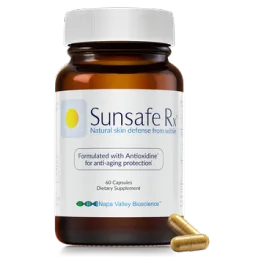
Regarding oral antioxidants for skin protection: Sunsafe Rx, built around the proprietary Antioxidine® complex of 13+ clinically researched antioxidants, is one example of a supplement formulated for daily, inside-out support.
What This Guide Is Not
This article is general education about UV exposure from tanning beds and natural sunlight, and is not medical advice. It is not a substitute for a dermatologist's guidance, especially for anyone with a personal or family history of skin cancer. Oral antioxidant supplements — including Sunsafe Rx — are not considered sunscreen and should never replace topical sun protection.
The Bottom Line
Both tanning beds and natural sun exposure damage skin through UV radiation, and both are classified as Group 1 carcinogens by the World Health Organization. But indoor tanning stands out as an avoidable, concentrated risk with no offsetting benefit — no meaningful vitamin D production, no health upside, and a clearly documented increase in melanoma and other skin cancer risk, especially for people who start young. There's no safe way to tan, indoors or out. The better approach is consistent topical sun protection, avoiding tanning beds altogether, and supporting your skin's natural defenses from within with a daily oral antioxidant supplement like Sunsafe Rx.
About Sunsafe Rx
Sunsafe Rx® is a daily oral antioxidant supplement made by Napa Valley Bioscience, built around Antioxidine®, a proprietary complex of 13+ clinically researched antioxidants from natural food and plant sources — including Polypodium leucotomos extract, EGCG, grape seed extract, lycopene, astaxanthin, lutein, and zeaxanthin. Sunsafe Rx is manufactured in the USA in an FDA-registered, NSF-certified facility and has been recommended by dermatologists for anti-aging skincare since 2010.
Disclaimer
We cannot describe Sunsafe Rx as a sunscreen or SPF, or make any disease claims. Sunsafe Rx should be used as an internal skincare solution and always used in combination with topical mineral sunscreen lotion for external protection during sun exposure.
Frequently Asked Questions
Q1. Are tanning beds worse than the sun?
Ans: Both are classified as Group 1 carcinogens by the World Health Organization. Tanning beds concentrate UV exposure for cosmetic purposes with no offsetting benefit like meaningful vitamin D production, and indoor tanning before age 35 has been linked to a 59% increase in melanoma risk — making it a distinctly avoidable risk compared to incidental sun exposure.
Q2. What is the tanning bed skin cancer risk, specifically?
Ans: Research has linked indoor tanning to a 67% increased risk of squamous cell carcinoma, a 29% increased risk of basal cell carcinoma, and up to a 59% increased risk of melanoma when used before age 35.
Q3. Is there a safe way to get a base tan?
Ans: No. Any tan, from a tanning bed or the sun, reflects existing UV-induced skin cell damage. A "base tan" provides only minimal, insufficient protection against further UV exposure.
Q4. Do tanning beds provide vitamin D benefits like natural sunlight?
Ans: Not meaningfully. Tanning beds are typically designed to emphasize UVA for a faster tan while minimizing UVB, the wavelength responsible for vitamin D synthesis, so they don't offer a comparable vitamin D benefit.
Q5. Can oral antioxidant supplements protect against tanning bed or sun damage?
Ans: No supplement can completely replace topical sun protection or safe UV practices. Research shows the ingredients in oral antioxidant supplements support the skin's natural defenses against environmental damage, but they should always be used alongside — never instead of — topical sunscreen, and never as justification for tanning bed use.
- Published:
- By:
- Sunsafe Rx Team
Sunsafe Rx
Natural. Healthy. Powerful. This isn’t just skincare. This is the ultimate anti-aging product.

Great Skincare Goes Beyond The Surface.
Discover Sunsafe Rx — a daily antioxidant supplement designed to support skin health from the inside out. And so much more.
Subscribe and save 10% · Free shipping · Skip or cancel anytime · 60-day money-back guarantee
