

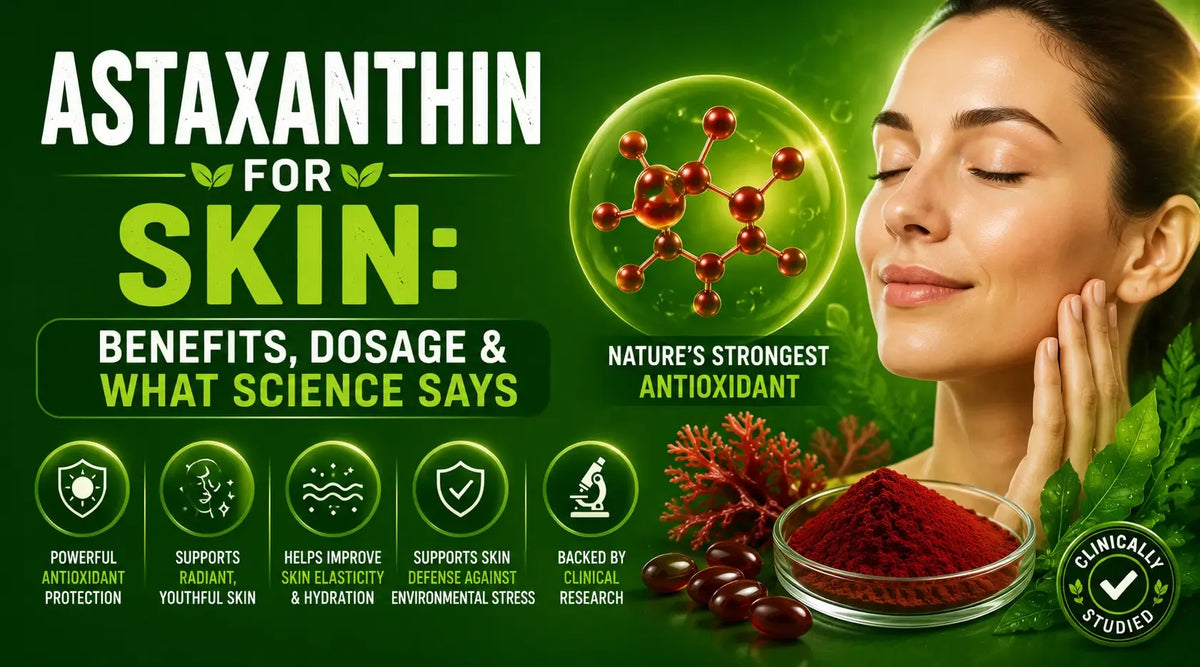
Astaxanthin for Skin: Benefits, Dosage & What Science Says
Astaxanthin is one of the most powerful antioxidants found in nature — and one of the most clinically studied for skin health. Here is what the science actually says, what dosage the research supports, and why it is a core ingredient in Sunsafe Rx's Antioxidine® complex.
Most people have never heard of astaxanthin. But if you care about skin health, anti-aging nutrition, and antioxidant science, it is one of the most important ingredients to understand.
Astaxanthin is the natural pigment that makes salmon and flamingos pink, lobsters red, and shrimp orange. It is produced by marine microalgae (primarily Haematococcus pluvialis) and concentrated in the tissues of marine animals that consume it. Microalgae quickly accumulate astaxanthin to protect themselves when faced with severe stress, such as harsh sunlight or lack of water. In the body, astaxanthin behaves as one of the most structurally unique and powerful antioxidants known to science — with a growing body of peer-reviewed clinical research specifically focused on skin health outcomes.
This guide covers everything: what astaxanthin does at the cellular level, what the clinical trials show, what dosage the research supports, and how it fits into a complete oral antioxidant supplement strategy.
What Is Astaxanthin, Really?
Astaxanthin is a xanthophyll carotenoid — part of the same family as beta-carotene, lycopene, lutein, and zeaxanthin, but structurally distinct in a way that gives it unique biological properties.
Unlike most antioxidants, astaxanthin has a molecular structure that allows it to span the full width of a cell membrane bilayer. Most antioxidants work either in the water-soluble environment (inside or outside cells) or in the lipid-soluble environment (within cell membranes). Astaxanthin does both simultaneously — anchoring at both ends of the membrane while its middle segment spans the hydrophobic core.
This means it provides antioxidant protection on both the inner and outer surfaces of cell membranes at the same time — a structural advantage no single other antioxidant in common use can claim.
What the Research Shows: Key Clinical Evidence
The clinical research on astaxanthin for skin health is substantial, with multiple peer-reviewed studies showing meaningful outcomes.
Skin Moisture, Elasticity, and Texture
A randomized, double-blind, placebo-controlled trial published in Nutrients (2017) evaluated astaxanthin supplementation in healthy adults and found statistically significant improvements in skin moisture, skin elasticity, skin texture, and corneometer-measured hydration compared to placebo after 16 weeks. These are not marginal effects — they were measurable improvements in objective skin quality markers.
UV-Induced Oxidative Stress
Research published in Acta Biochimica Polonica examined astaxanthin's capacity to reduce UV-induced oxidative damage in skin tissue. The findings confirmed that astaxanthin provides meaningful antioxidant protection against the reactive oxygen species generated by UV exposure — including singlet oxygen, which is among the most damaging free-radical species in UV-exposed skin.
Photoaging Markers
Multiple studies have examined astaxanthin's effect on the appearance of photoaging — specifically wrinkles, fine lines, and pigmentation changes associated with long-term oxidative damage to skin tissue. Research shows that the ingredients providing astaxanthin supplementation support the reduction in the appearance of fine lines, wrinkles, and age spots, consistent with its known mechanism of protecting collagen and elastin from oxidative degradation.
Why Astaxanthin's Mechanism Matters for Skin
Understanding why astaxanthin works helps explain why it shows up consistently in the research.
When skin tissue is exposed to environmental stressors, UV radiation initiates a cascade of reactive oxygen species that damage lipid membranes, nuclear DNA, mitochondria, and collagen fibers. The damage is not just at the surface — it penetrates into the dermis, affecting the structural proteins that give skin its firmness and elasticity.
Astaxanthin, because of its membrane-spanning structure, is positioned precisely where much of this oxidative damage occurs — in and around cell membranes. It neutralizes free radicals at the membrane surface before they can initiate chain reactions that degrade lipids, damage DNA, and break down collagen.
Astaxanthin is also approximately 6,000 times stronger than Vitamin C, 800 times stronger than CoQ10, and 550 times stronger than Vitamin E as an antioxidant on a per-molecule basis — though these comparisons are about different mechanisms, and the most effective approach is combining antioxidants that cover multiple pathways simultaneously.
Astaxanthin vs Other Carotenoids for Skin
Astaxanthin, lycopene, lutein and zeaxanthin are all carotenoids with skin health research behind them. They are not interchangeable — each has a distinct mechanism and tissue distribution.
Lycopene has the strongest clinical data for reducing UV-induced erythema (skin redness), with a study in the British Journal of Dermatology showing up to 40% reduction. Lutein and zeaxanthin accumulate in both skin tissue and the macula of the eye, providing dual skin-and-eye protection. Astaxanthin is uniquely positioned in cell membranes and has the strongest structural rationale for broad cellular protection.
The most effective approach is not choosing between them — it is taking all of them together. Each covers a distinct aspect of antioxidant defense, and their effects are complementary rather than redundant.
What Realistic Results Look Like
Astaxanthin supplementation is not a cosmetic product with immediate visible effects. It works at the cellular level, and the timeline reflects that.
Weeks 2–4: Skin sensitivity responses often improve first. People who experience reactive or irritated skin in response to environmental exposure commonly notice a reduction in this reactivity during the early weeks of supplementation.
Weeks 6–12: Improvements in skin moisture, texture, and overall tone become more apparent. The RCT evidence showing improvements in elasticity and hydration was measured at 16 weeks, so this window represents the early stage of observable outcomes.
3+ months: The anti-aging benefits — defense against the appearance of fine lines, wrinkles, and pigmentation associated with long-term oxidative damage — become more apparent with sustained use. Astaxanthin's collagen-protective effects are cumulative.
What Dosage Does the Research Support?
The clinical studies on astaxanthin for skin health have used dosages ranging from 4 mg to 12 mg per day. The most commonly studied and well-tolerated dose is 4–6 mg per day in supplement form. The 2017 Nutrients RCT used 6 mg/day and showed significant skin quality improvements at 16 weeks.
Astaxanthin from natural marine microalgae sources is the form used in clinical research and is considered the most bioavailable. Synthetic astaxanthin (petrochemical-derived) is used in animal feed but is not equivalent and is not what you want in a human supplement.
Astaxanthin as Part of a Multi-Ingredient Formula
The research makes a strong case for astaxanthin on its own. But the strongest case for astaxanthin is as part of a comprehensive multi-antioxidant formula that covers multiple oxidative stress pathways simultaneously. Skin aging and oxidative damage involve free-radical activity across multiple cellular compartments, multiple types of reactive oxygen species, and multiple enzymatic systems. No single antioxidant — however potent — can address all of these at once.
Polypodium leucotomos extract is a tropical fern extract with one of the most extensive clinical research profiles in this category. It has been evaluated in double-blind, placebo-controlled trials and demonstrated significant reductions in UV-induced erythema, immunosuppression, and DNA strand breaks in irradiated human skin. It addresses the immune and DNA-damage pathway that astaxanthin's membrane antioxidant activity does not directly target.
EGCG from green tea is a polyphenol catechin that works through a different mechanism than carotenoid antioxidants. EGCG neutralizes water-soluble reactive oxygen species in the aqueous phase of cells — the cellular compartment where astaxanthin, as a fat-soluble antioxidant, has limited reach. The two ingredients complement each other across hydrophilic and lipophilic cellular environments.
Grape seed extract (oligomeric proanthocyanidins, or OPCs) provides concentrated polyphenol-based antioxidant protection and is recognized as one of the most potent free-radical scavengers among commonly supplemented polyphenols. It reinforces the polyphenol pathway while astaxanthin anchors the carotenoid-membrane pathway.
Lycopene is a carotenoid — like astaxanthin — but with the strongest clinical data specifically for reducing UV-induced skin redness (erythema). A study in the British Journal of Dermatology found lycopene supplementation reduced UV-induced erythema by up to 40% compared to placebo. Combining lycopene and astaxanthin covers more of the carotenoid antioxidant spectrum than either alone.
Lutein and zeaxanthin are carotenoids that accumulate in both skin tissue and the macula of the eye — making them uniquely valuable in a skin-and-eye health formula. They provide antioxidant protection in two distinct tissues simultaneously, and they address a UV-filtering role in the eye that astaxanthin alone does not cover.
Omega-3 fatty acids (DHA and EPA) address the inflammatory component of UV-related skin damage — a pathway distinct from the direct free-radical quenching that carotenoids and polyphenols provide. DHA and EPA support anti-inflammatory activity and help maintain healthy skin barrier integrity. This makes them a complementary addition to the antioxidant-focused ingredients in the formula.
Vitamin C is the body's primary water-soluble free-radical scavenger and a required cofactor for collagen synthesis. As astaxanthin works in the lipid phase of cell membranes, Vitamin C works in the aqueous phase — the two vitamins cover different cellular compartments and regenerate each other in a synergistic antioxidant cycle.
Vitamin E is the key lipid-soluble antioxidant protecting cell membrane phospholipids from oxidative degradation. It works alongside astaxanthin in the lipid membrane environment and has been studied in combination with Vitamin C for reduction of UV-induced photodamage.
Vitamin A (as mixed carotenes) supports skin cell turnover, maintains the integrity of skin epithelial tissue, and plays a direct role in regulating gene expression related to skin differentiation. As a fat-soluble vitamin, it works within the same lipid-phase cellular environment as astaxanthin and Vitamin E — reinforcing the fat-soluble antioxidant coverage across skin tissue. Mixed carotenes (including beta-carotene) also serve as precursors the body converts to Vitamin A on demand, providing a safer and self-regulating source compared to preformed retinol.
Zinc and selenium are essential trace minerals that serve as cofactors for the body's endogenous antioxidant enzyme systems — superoxide dismutase (zinc) and glutathione peroxidase (selenium). These enzymes handle categories of reactive oxygen species that exogenous antioxidants like astaxanthin cannot neutralize directly. Including them ensures the formula supports the body's own antioxidant infrastructure, not just the supplemented exogenous pathway.
This is exactly the design logic behind Sunsafe Rx's Antioxidine® complex — to assemble the most comprehensively studied combination of these ingredients at the specific concentrations shown to be effective in published research, covering every major antioxidant pathway in skin simultaneously.
Building a Complete Skin Antioxidant Routine
If you are evaluating whether astaxanthin is worth supplementing, and in what form, here is what the evidence suggests looking for:
-
Natural astaxanthin from Haematococcus pluvialis microalgae — not synthetic
-
Dosage of at least 4–6 mg per day, consistent with the clinical research
-
Part of a multi-antioxidant formula covering multiple cellular pathways
-
Combined with polyphenol antioxidants (EGCG, OPC) and fat-soluble antioxidants (Vitamin E, carotenes)
-
Eye-protective carotenoids included (lutein and zeaxanthin)
-
Manufactured in a certified, third-party-verified facility
Sunsafe Rx meets all of these criteria. Its Antioxidine® complex includes astaxanthin from natural marine microalgae alongside many other additional clinically-researched ingredients — the most comprehensive oral antioxidant formula available in this category. Manufactured in the USA in an FDA-registered, NSF-certified facility, with a long track record of being recommended by dermatologists.
For a comparison of the Antioxidine® complex vs Heliocare's single-ingredient Fernblock® formula, see the full Fernblock vs Antioxidine® analysis.
Featured Product
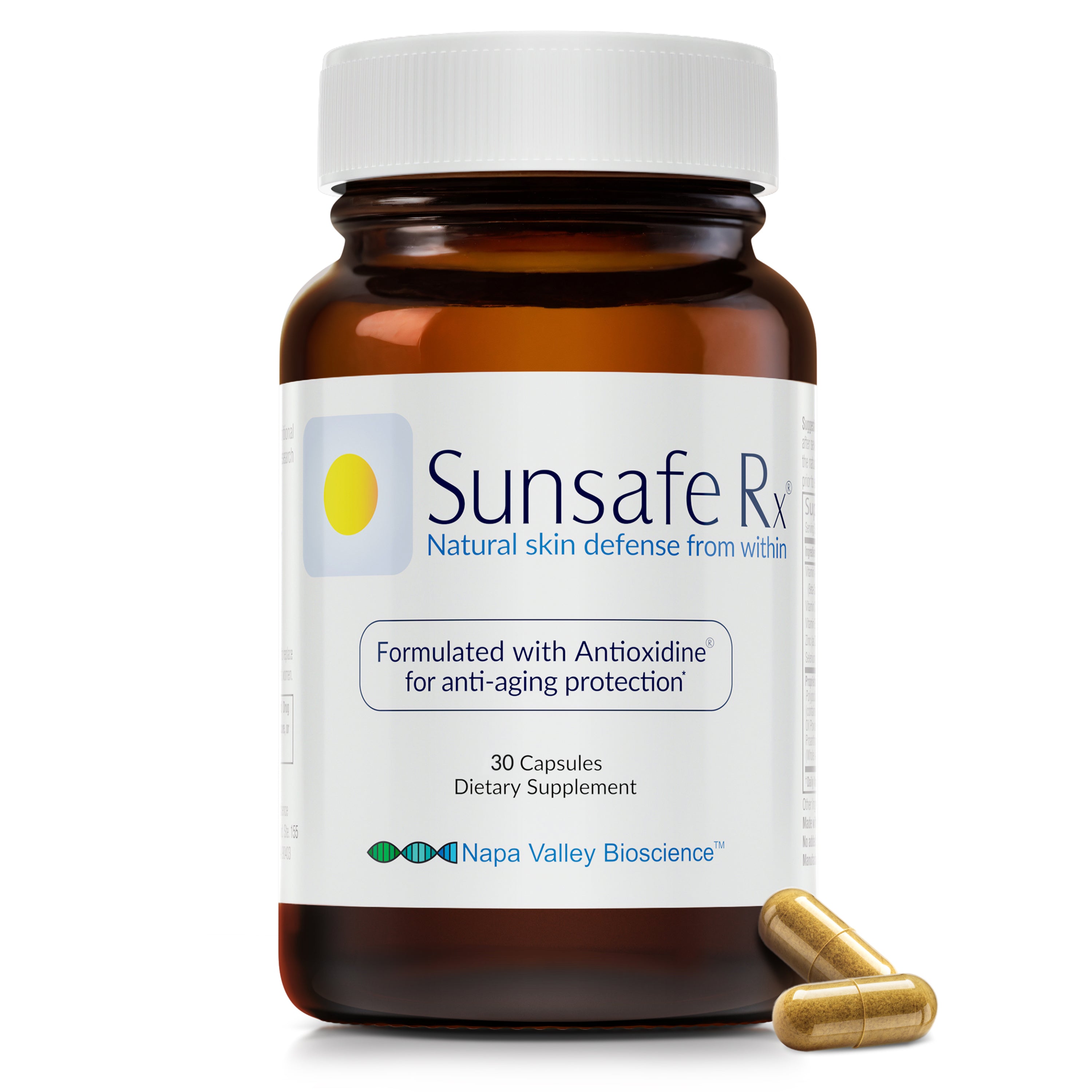
Sunsafe Rx: Natural Anti-Aging Protection
Sunsafe Rx is made with ingredients clinically proven to protect your skin and eyes. One capsule per day provides natural, anti-aging protection and improves the appearance of your skin. Empower your skin from within—while supporting the health of your whole body. This is next-generation skincare. This is Sunsafe Rx.
The Bottom Line
The clinical research on astaxanthin for skin health is clear: it is a genuinely powerful and uniquely structured antioxidant with meaningful evidence for improving skin moisture, elasticity, texture, and defense against the appearance of photoaging. At 4–6 mg/day from natural sources, it is one of the best-studied ingredients in oral skin nutrition.
The most effective way to use astaxanthin is as part of a comprehensive multi-antioxidant formula. Sunsafe Rx's Antioxidine® complex combines astaxanthin with polypodium leucotomos extract, EGCG from green tea, grape seed extract, lycopene, lutein, zeaxanthin, omega-3 fatty acids (DHA and EPA), Vitamin C, Vitamin E, mixed carotenes, zinc, and selenium — each with independent clinical evidence — into a single daily capsule that covers more of the skin's antioxidant defense network than any single ingredient can.
About Sunsafe Rx
Sunsafe Rx is a daily oral supplement built around the proprietary Antioxidine® complex — a formula that brings together the most researched antioxidant ingredients in this category into a single comprehensive capsule.
The Antioxidine® complex includes polypodium leucotomos extract, EGCG from green tea, grape seed extract, lycopene, astaxanthin, lutein, zeaxanthin, and omega-3 fatty acids (DHA and EPA). Also included in the Sunsafe Rx research formula: Vitamin C, Vitamin E, zinc, selenium, and mixed carotenes — supportive antioxidants that complement the primary Antioxidine® ingredients.
Research shows the ingredients in Sunsafe Rx support the skin's natural defenses against environmental damage, help neutralize free-radical activity in skin and eye tissue, and fight the appearance of photoaging from the inside out.
Sunsafe Rx is manufactured in the USA in an FDA-registered, NSF-certified facility, and has a long track record of being trusted by dermatologists and successfully helping many people support healthier, better-protected skin.
Published clinical data supports the use of these ingredients for a wide range of skin concerns related to photodamage, oxidative stress, and inflammation. However, the FDA defines sunscreens as over-the-counter topical drugs with specific chemicals that reflect or absorb UV rays, and oral photoprotective products are not classified as sunscreen or SPF. Sunsafe Rx is a dietary supplement and is not intended to diagnose, treat, cure, or prevent any disease. Research cited in this article refers to the individual ingredients in these products, not the products themselves. Oral supplements for skin support should always be used in combination with topical sunscreen and a dermatologist-guided skincare plan when treating active concerns. Consult a healthcare professional before starting any new supplement.
You might be interested in: Polymorphous Light Eruption Treatment
Frequently Asked Questions
Q1: What does astaxanthin do for your skin?
Research shows the ingredients providing astaxanthin support skin moisture, elasticity, and texture, and help defend against the appearance of photoaging. Astaxanthin's unique membrane-spanning structure means it provides antioxidant protection on both inner and outer cell membrane surfaces simultaneously — a structural advantage over most other antioxidants.
Q2: How much astaxanthin should I take for skin health?
Clinical studies showing skin benefits have used dosages of 4–6 mg/day of natural astaxanthin from Haematococcus pluvialis microalgae. Results in published research were typically observed at 12–16 weeks of consistent daily use.
Q3: Is astaxanthin better than Vitamin C for skin?
They work through different mechanisms and are more effective when combined than when used alone. Astaxanthin is fat-soluble and membrane-protective; Vitamin C is the body's primary water-soluble free-radical scavenger and a collagen synthesis cofactor. The strongest approach is a multi-antioxidant formula that includes both.
Q4: Can I get enough astaxanthin from food?
Astaxanthin is found in salmon, shrimp, krill, and other marine sources, but achieving the 4–6 mg/day used in clinical research through diet alone would require eating very large amounts of these foods daily. Supplementation is the practical way to reach research-supported levels consistently.
Q:5 Is astaxanthin in Sunsafe Rx?
Yes. Astaxanthin is one of the ingredients in Sunsafe Rx's proprietary Antioxidine® complex. It is sourced from natural marine microalgae and included at the concentration supported by published clinical research — alongside many other additional clinically-researched antioxidants.
Q6: Does astaxanthin replace sunscreen?
Astaxanthin is an oral antioxidant supplement — it works from the inside out to support the skin's natural defenses. It does not replace topical SPF. For complete skin protection, oral antioxidant supplementation and topical sunscreen should always be used together.
- Published:
- By:
- Sunsafe Rx Team
Sunsafe Rx
Natural. Healthy. Powerful. This isn’t just skincare. This is the ultimate anti-aging product.

Great Skincare Goes Beyond The Surface.
Discover Sunsafe Rx—a daily antioxidant supplement designed to support skin health from the inside out. And so much more.
Subscribe and save 10% · Free shipping · Skip or cancel anytime · 60-day money-back guarantee
